

The Best Klaviyo Email Flows: What to Build, In What Order, and What to Expect
 Ryan Kodzik
Klaviyo flows account for 20 to 30 percent of email revenue for most DTC brands, and the gap inside that range comes down to which flows are live and how well the triggers are built. Most Shopify brands build flows in the wrong order, skip the segmentation logic that makes each one profitable, and treat the welcome series as a set-and-forget asset instead of the highest-leverage test bed in their entire stack. This guide covers the seven Klaviyo flows that drive the most revenue for DTC brands doing $1M to $10M on Shopify, the order to build them in, and the benchmarks to hold each one against. Future Holidays has built and optimized Klaviyo flow architecture for Shopify DTC brands across supplements, apparel, and consumables, so this reflects what works at scale, not what the default templates suggest.
Why does flow architecture matter more than individual emails?
Flows compound. Campaigns do not. One well-configured abandoned cart flow earns revenue every day with no additional spend, while a campaign earns once and then it is gone. That difference is why automated flows generate close to 41 percent of email revenue from roughly 5 percent of total sends, according to Klaviyo’s 2026 benchmark data.
The problem for most brands is structural, not creative. They have three flows live when they need seven, and the three they have are under-segmented. A welcome series that treats a price-led subscriber the same as a referral, or an abandoned cart flow with no purchase suppression, leaks revenue quietly every single day. Fix the architecture first. The copy comes second. Working on this for your store?
What are the seven Klaviyo flows every DTC brand needs, and in what order?
Build order matters more than most brands assume. You want each flow to capture the highest-intent moment available before you move down the list. Build them in this sequence.
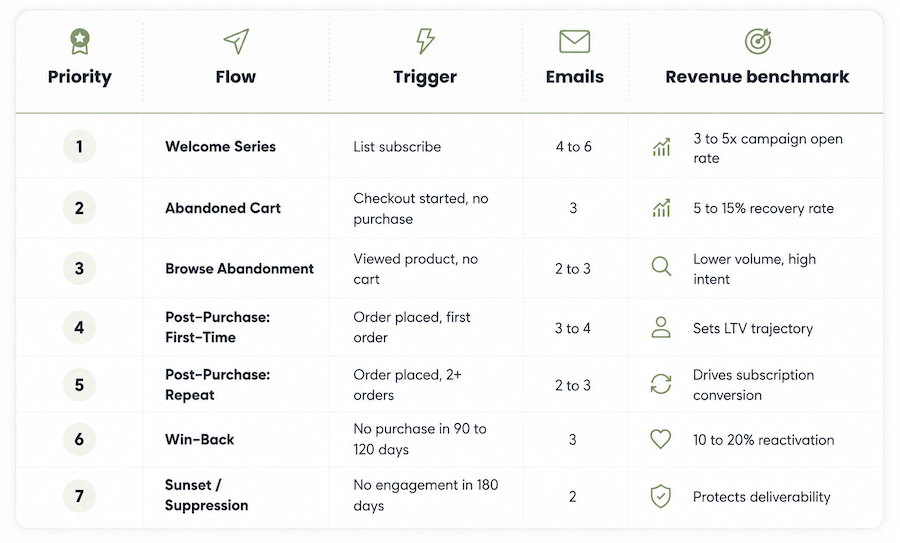
The welcome series goes first because new subscribers are at peak intent and it doubles as your highest-traffic testing ground for subject lines and offers. Abandoned cart goes second because it recovers revenue you have already half-earned. Everything after that protects and extends customer value once the front of the funnel is working.
How do you configure each Klaviyo flow in Klaviyo?
Every flow starts the same way. Go to Flows, click Create Flow, and choose a pre-built template or build from scratch. Templates are fine to start, but the configuration below is where the revenue actually lives.
Welcome Series. Trigger on a list subscribe (your newsletter or signup-form list). Send email 1 immediately, email 2 after one day, then space the rest two to three days apart. Leave smart sending on so a new subscriber who is also mid-purchase does not get double-messaged. The filter most brands skip: a conditional split that removes anyone who placed an order after joining, so first-time buyers stop getting “subscribe and save 10 percent” prompts they already acted on.
Abandoned Cart. Trigger on the Checkout Started metric, not Added to Cart, which fires too early and too often. Send email 1 at one hour, email 2 at 24 hours, email 3 at 48 to 72 hours. Turn smart sending off here. This flow is time-sensitive and high-intent, and you want it to fire every time. The filter most brands skip: a conditional split before each email that excludes anyone who placed an order since starting the flow, so recovered customers stop receiving “you left something behind” emails after they bought.
Browse Abandonment. Trigger on Viewed Product with a filter that the person did not start checkout. Two to three emails, lighter on discount and heavier on product education. Keep smart sending on, and add a flow filter that suppresses anyone currently in the abandoned cart flow so the same subscriber is not hit by both at once.
Post-Purchase, First-Time. Trigger on Placed Order with a conditional split where order count equals one. Lead with a thank-you and what to expect, follow with usage or education timed to the product’s first-use window, then ask for a review and introduce a relevant cross-sell. This flow sets the LTV trajectory for every new customer.
Post-Purchase, Repeat. Same Placed Order trigger, split where order count is two or more. This is where you drive subscription conversion and replenishment, since these buyers have already proven intent.
Win-Back. Trigger off lapsed-customer recency, and segment by bucket. A 90-day lapsed buyer and a 180-day lapsed buyer need different messages and different incentives.
Sunset. Trigger on no opens or clicks in 180 days, send two final re-engagement attempts, then suppress. This protects your sender reputation so the other six flows keep landing in the inbox.
One supplements brand we work with saw abandoned cart recovery move from roughly 6 percent to 13 percent after we split the flow by cart value and rebuilt the purchase-suppression logic over a single quarter.
What are good Klaviyo flow benchmarks for DTC brands in 2026?
Use these as targets, then read them with one caveat below. Klaviyo’s 2026 benchmark data shows flow emails averaging a 5.58 percent click rate, more than three times the 1.69 percent campaign average, with top performers above 10 percent. Flow placed-order rates average around 2.1 percent and reach 4.3 percent for the top tier. Welcome flows commonly post open rates in the 40 to 60 percent range, well above campaign averages. Revenue per recipient for top-performing flows climbs as high as $7.79, far ahead of what campaigns produce.
Here is the caveat that separates a useful benchmark from a vanity one. Open rate is skewed by list quality and by Apple Mail Privacy Protection, which inflates opens. A clean, double-opt-in list will post higher opens regardless of how good the flow is. Click rate, conversion rate, and revenue per recipient reflect flow design, which is what you actually control. When you audit a flow, weight revenue per recipient and conversion rate above open rate every time.
What setup mistakes kill Klaviyo flow performance?
Four mistakes cost brands more revenue than any copy problem.
Running abandoned cart and browse abandonment with no suppression between them. A subscriber who browsed, then started checkout, lands in both flows and gets hammered. Engagement drops and spam complaints rise. Fix it with a flow filter that excludes anyone active in the cart flow from the browse flow.
A welcome series that opens with a discount and nothing else. This trains subscribers to wait for an offer before they buy, and it erodes margin on every future order. Lead with value, brand, and proof, then introduce an incentive later in the sequence if you need one.
A one-email post-purchase flow. A single thank-you email misses the window to drive the second purchase, which is the highest-leverage action for LTV once you are past $5M in revenue. Build three to four emails that move a first-time buyer toward order two.
A win-back flow aimed at the entire unengaged list. A 90-day lapsed customer and a 180-day lapsed customer are not the same person. Segment by recency bucket and set different suppression thresholds, or you waste sends on contacts who are already gone and risk deliverability for the ones worth saving.
When should you manage Klaviyo flows in-house vs. hire an agency?
This comes down to revenue stage and bandwidth, not whether an agency can technically do it better.
Under $1M, build flows in-house using Klaviyo’s templates. The time cost is manageable and agency-level optimization will not move the number enough to justify the spend.
From $1M to $3M, in-house works if one person owns email full-time. The inflection point arrives when A/B testing backlogs and segmentation complexity outgrow what that person can handle alongside running campaigns.
From $3M to $10M, flow architecture starts costing real money when it is wrong. Suppression errors, missing post-purchase splits, and an untested welcome series email 1 become measurable revenue leaks at this volume.
Future Holidays works with Shopify DTC brands at $5M and above that already have basic flows live but need advanced segmentation, multi-variate testing infrastructure, and flow architecture that scales with catalog growth and subscriber volume.
Working on this for your store? Talk to our team →
Frequently Asked Questions
What is the most important Klaviyo flow to set up first?
The welcome series is the highest-priority flow for any DTC brand starting from scratch. New subscribers are at peak engagement when they join your list, and welcome flows average three to five times the open rate of standard campaigns. A four-to-six email series that leads with value before introducing a discount outperforms a single discount email on both short-term conversion and long-term subscriber LTV.
How many emails should a Klaviyo abandoned cart flow have?
Three emails is the standard for DTC brands: one at one hour after checkout, one at 24 hours, and one at 48 to 72 hours. Each email needs a distinct job. The first recovers high-intent browsers, the second answers objections, and the third adds light urgency or a soft incentive. Add a filter to every email that suppresses anyone who completed a purchase after the trigger fired, so recovered customers stop getting reminders.
What is a good open rate for Klaviyo flows?
Flow open rates commonly land between 35 and 60 percent depending on the flow, with welcome series at the high end. Treat open rate as a directional signal rather than a primary metric, since Apple Mail Privacy Protection inflates it. Click rate, conversion rate, and revenue per recipient tell you far more about whether a flow is actually earning.
How long does it take to set up Klaviyo flows?
A core set of three flows, welcome, abandoned cart, and post-purchase, takes most teams two to four hours to build from templates and a few more to configure the triggers and filters correctly. Building all seven flows with proper segmentation is closer to a week of focused work. The build is fast. The optimization is ongoing.
Do Klaviyo flows work for DTC brands under $1M in revenue?
Yes. Flows are the highest-ROI email work a small brand can do, because they earn revenue automatically once live. At under $1M, build them in-house with Klaviyo’s templates and focus on the welcome and abandoned cart flows first. Agency-level optimization becomes worth the cost once email is driving meaningful revenue and testing complexity grows.
How often should you test or update your Klaviyo flows?
Review flow performance monthly and run at least one A/B test per priority flow each quarter. Welcome series email 1 subject lines, abandoned cart timing, and post-purchase cross-sell offers are the highest-leverage things to test. Update flows whenever your catalog, pricing, or audience shifts, since stale triggers and offers quietly drag down revenue per recipient.
If your flows are live but underperforming, the issue is almost always architecture and segmentation, not copy. We rebuild Klaviyo flow systems for Shopify DTC brands so each flow earns at the top of its benchmark range. Talk to our team
Ready to put this into practice?
We build and grow Shopify stores for DTC brands, from store design and development to Klaviyo and full-scale CRO programs. If you want to talk through what this looks like for your store, book a call. No pitch, just a conversation.
Book a discovery callRelated Articles