

How to Choose a Shopify Agency to Grow a DTC Brand
 Ryan Kodzik
Most Shopify agencies are built to launch stores, not scale them. A DTC brand past $5M needs a partner who connects store work to revenue, retention, and lifetime value, not one that hands over a theme and disappears. The right agency shows three things: platform specialization, ownership of the metrics it touches, and proof from comparable brands. This guide covers the criteria that matter at $5M+, the questions to ask before you sign, and how to tell real growth depth from a broad service menu.
What does a Shopify agency actually do for a DTC brand?
A Shopify agency manages and grows a brand’s store on the Shopify platform. The work splits into two tracks, and the one you need depends on where your brand is.
The first track is build work: design, theme development, custom features, app setup, and migrations. If your store is dated, slow, or about to replatform, this is the partner you want. We do this work, and a strong build sets the foundation for everything after it.
The second track is growth work: conversion rate optimization, retention and email, average order value, and subscription programs. This is everything that moves revenue after the store is live.
Most brands past $5M already have a working store. What they need is more revenue from the traffic they already have, which makes growth the track that compounds. A fast, well-built store still leaves money on the table without a partner who owns the metrics that grow revenue over time. If you need a build or a redesign first, start there, then move to growth.
💡 Recommended Reading: How to Choose a Shopify Development Agency for a Custom Build or Redesign
What should you look for in a Shopify agency at $5M+?
At this revenue tier, the agency you pick should clear five criteria:
- Shopify-primary focus, not one of eight platforms. Depth on one platform beats shallow coverage across many. You want a team that knows Shopify’s checkout, APIs, and app ecosystem cold.
- DTC experience at your revenue tier. Scaling a $500K store and a $10M store are different problems. Ask for work with brands your size.
- Owned-channel depth. Look for real capability across CRO, Klaviyo and retention, and subscription. These are the channels you control and the ones that drive LTV.
- Named, specific case results. Percentages, timeframes, and category. Vague claims about “significant lifts” mean nothing. You want numbers tied to brands you can picture.
- A focused retainer scope. A clear set of outcomes the agency owns beats an everything menu. Breadth dilutes accountability.
💡 Recommended Reading: How to Choose a Shopify CRO Agency for Conversion Testing
What questions should you ask before hiring a Shopify agency?
Bring these to any pitch. The answers separate operators from order-takers.
- What revenue tier are most of your clients at right now?
- Which metric will you own, and how will we measure it?
- Can you show me results from a brand in my category and at my size?
- Who actually does the work, and who will I talk to week to week?
- What does the first 90 days look like, and what should I expect to see?
- How do you decide what to work on next, and do you bring that roadmap to me or wait for requests?
- What happens if a test or a flow underperforms?
- What does your reporting look like, and how often do we review it?
An agency that answers these directly, with specifics, is one that has done this before.
💡 Recommended Reading: How to Choose a Klaviyo Agency for Email and SMS
How do you tell a growth agency from a development shop?
A development shop executes tasks. You send a ticket, they build it, they bill you. Useful for a redesign or a migration. Not built to grow revenue.
A growth agency owns outcomes. It commits to a metric, builds a roadmap to move it, and brings the next priority to you before you ask. It speaks in LTV and CAC, not in hours and tickets. It treats your store as a system where conversion, retention, and AOV compound, and it works all three because moving one without the others leaves growth on the table. When you ask “what should we do next quarter,” a growth agency already has an answer.
💡 Recommended Reading: How to Choose a Shopify Development Agency for a Custom Build or Redesign
How Future Holidays approaches this work
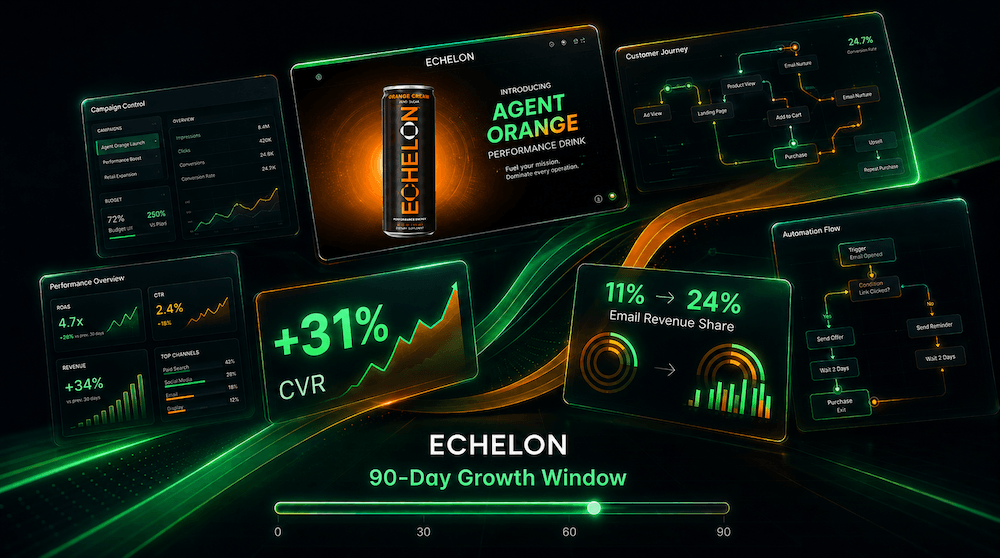
We work with established DTC brands on Shopify, most in the $5M+ range, where repeat purchase and lifetime value decide whether growth holds. One brand came to us after their conversion rate plateaued for three quarters. We rebuilt their product pages and checkout and saw conversion climb inside the first 60 days.
We own three pillars: conversion rate optimization, Klaviyo and retention, and subscriptions. We work all three together because they compound. A higher conversion rate feeds more customers into retention flows, retention raises repeat purchase, and subscriptions turn repeat buyers into predictable revenue. Owning one without the others caps the result.
If you’re choosing a partner to scale a DTC brand on Shopify, that’s the model worth looking for. Talk to our team →
Frequently Asked Questions
What should a DTC brand look for in a Shopify agency?
Look for Shopify-primary focus, proven work at your revenue tier, and depth across the channels you own: conversion, retention, and subscriptions. The agency should commit to a specific metric and show named results with real percentages and timeframes. Avoid generalists who cover eight platforms and offer an everything menu, because breadth dilutes accountability.
How does a Shopify agency increase revenue for a DTC brand?
A growth-focused agency raises revenue by improving conversion rate, lifting average order value, and increasing repeat purchase through retention and subscriptions. It runs CRO tests on product pages and checkout, builds automated email flows in Klaviyo, and structures subscription offers that turn one-time buyers into recurring revenue. These levers compound, so working them together produces more than any one alone.
When should a DTC brand hire an agency instead of building in-house?
Hire an agency when growth has stalled and you lack the specialized skills to fix it, or when building an in-house team would cost more and take longer than you can afford. Agencies bring experience across many brands, so they reach proven tactics faster. In-house makes sense once the work is steady, predictable, and large enough to keep a full team busy.
What does a Shopify agency retainer typically include?
A focused retainer usually covers a defined set of outcomes: ongoing CRO and testing, email and retention management, subscription strategy, and regular reporting against an agreed metric. Scope and price vary with the depth of work and the agency’s revenue tier. The clearest retainers name the metric the agency owns and the cadence of review, rather than billing loose hours.
How long does it take to see results from a Shopify agency?
Early conversion and email wins often show inside the first 60 to 90 days, since CRO tests and abandoned-cart flows move quickly. Retention and subscription gains take longer, usually three to six months, because they depend on repeat purchase behavior building over time. A good agency sets these expectations upfront and reports progress against them.
What separates a growth-focused Shopify agency from a development shop?
A development shop executes tasks you assign and bills for the build. A growth agency commits to a revenue metric, builds a roadmap to move it, and brings the next priority to you proactively. The growth agency speaks in LTV and CAC and treats conversion, retention, and AOV as one connected system rather than a list of tickets.
Ready to put this into practice?
We build and grow Shopify stores for DTC brands, from store design and development to Klaviyo and full-scale CRO programs. If you want to talk through what this looks like for your store, book a call. No pitch, just a conversation.
Book a discovery callRelated Articles