

The CPG Brand’s Problem with Agentic Commerce Isn’t Discovery — It’s Data
 Ryan Kodzik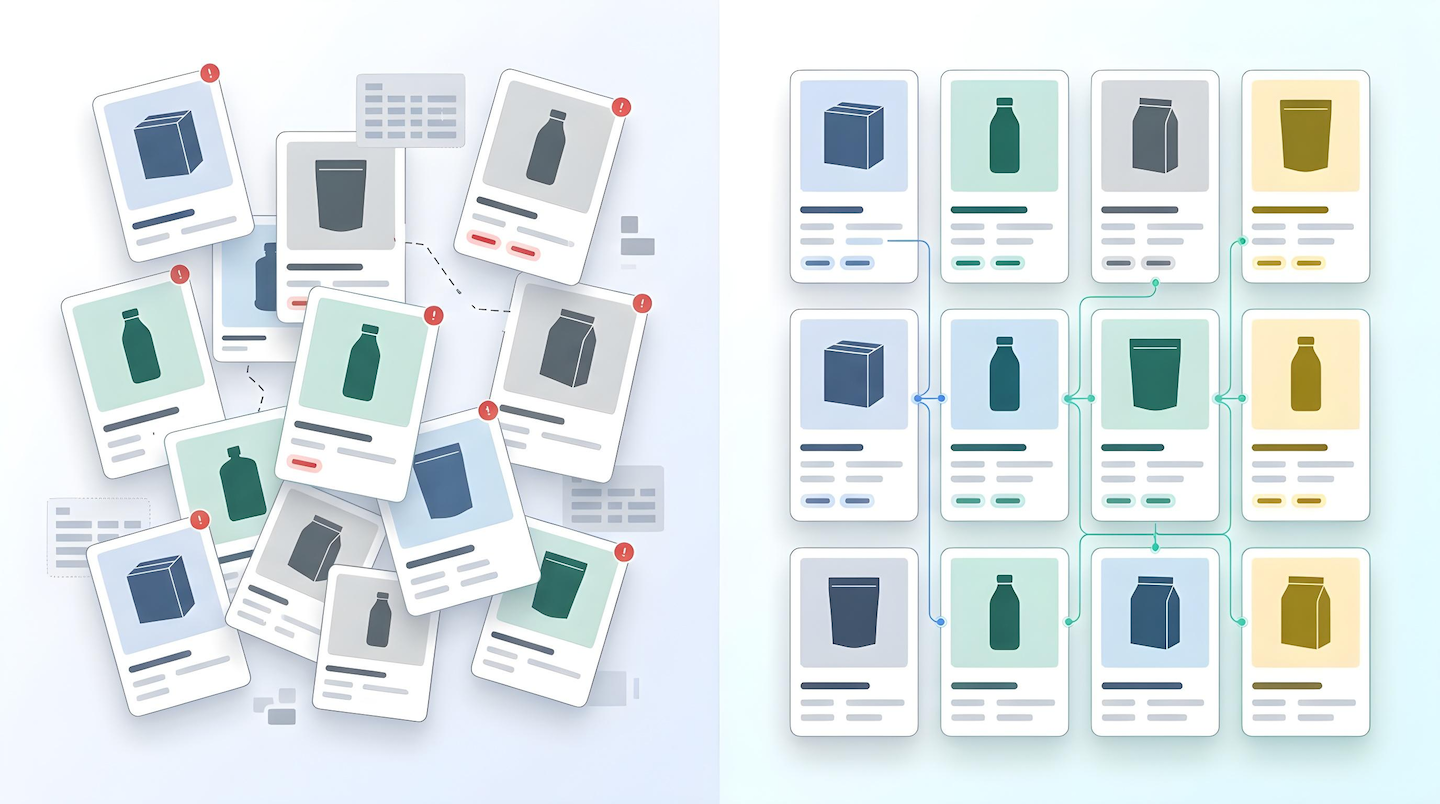
AI shopping channels are live. Shopify Agentic Storefronts launched by default in late March, and ChatGPT, Google AI Mode, and Microsoft Copilot are all surfacing products in active conversations. For most DTC brands, showing up on these channels is now automatic. For CPG and Food & Beverage brands, it’s more complicated — and the reason has nothing to do with the technology.
The problem is data.
Why CPG Catalogs Break on AI Channels
When an AI agent evaluates which protein powder to recommend to someone asking for “high-protein, low-sugar, chocolate flavor under $40,” it’s not browsing your storefront. It’s parsing your product data — titles, descriptions, attributes, certifications, variants — and deciding whether it can confidently match your product to that query.
CPG brands, more than almost any other category, have messy catalogs. Not because they’re careless, but because the category demands complexity. High SKU counts, multiple pack sizes, flavor variants, ingredient nuances, dietary certifications, subscription options — all of it creates layers of data that were built for human navigation, not machine parsing.
Google put it plainly in their January 2026 guidance for CPG brands: if your product uses sustainable packaging but that attribute isn’t structured and tagged in your data, an AI agent searching for “verified sustainable packaging” won’t find you. The same applies to allergen information, occasion tags, dietary claims, and format descriptors. The attribute exists in your brand story. It doesn’t exist in your catalog where it needs to be.
This is what makes agentic commerce a data problem before it’s anything else.
💡 Recommended Reading: Your Shopify Store Is Live on ChatGPT — Is It Ready
What Agents Actually Need to Recommend You
An AI agent working on a shopper’s behalf needs to do three things: find your product, evaluate it against the shopper’s criteria, and complete or refer the transaction. Each step depends on your data being readable, accurate, and complete.
Discovery
requires your titles and descriptions to use the language shoppers actually use in conversational queries — not internal naming conventions or marketing headlines. “Chocolate Fudge 2lb Resealable Bag” is a human-readable product name. “High-protein chocolate recovery shake, 30g protein per serving, low sugar, resealable 2lb pouch” is what an AI agent can actually match to a shopper query.
Evaluation
requires attributes that agents can parse: certifications (USDA Organic, Non-GMO, Keto-certified), dietary claims (gluten-free, vegan, allergen statements), use case tags (pre-workout, post-workout, meal replacement), and accurate, real-time pricing and inventory. If any of this is missing or buried in lifestyle copy, the agent skips your product.
Transaction
requires that when a shopper lands on your product page — redirected from ChatGPT or Google AI Mode — the page earns the purchase. The agent did the discovery work. Now your PDP has to close it.
The F&B Variant Problem
Food and beverage brands face a specific version of this challenge that most agentic commerce coverage glosses over: variant complexity.
A single product line might have eight flavors, three sizes, and a subscription option — that’s potentially 48 SKU combinations. When those variants aren’t properly consolidated and attributed, AI platforms see fragmented product entities rather than a coherent offering. Shopify Catalog tries to handle some of this automatically, but the output is only as clean as the input.
The brands showing up well in AI recommendations are the ones who’ve treated their catalog like a structured data asset — not just a product listing feed. Flavor variants grouped with consistent naming. Nutritional attributes tagged at the variant level. Subscription options clearly described with pricing logic an agent can understand. Certifications attached to every product they apply to, not just the brand page.
If your catalog wasn’t built with this structure, the agentic storefront activation that happened automatically in late March surfaced whatever you had — gaps, inconsistencies, and all.

Discovery Is Only Half the Problem
There’s a second layer that matters just as much: what happens after the click.
AI-referred shoppers tend to be high-intent. They’ve already had a conversation with an agent that helped them narrow options, compare products, and decide they want yours. By the time they land on your product page, most of the consideration work is done. That’s a strong signal — and it means the post-click experience determines whether the revenue actually happens.
A weak PDP, a slow mobile load, a checkout with too much friction, or missing social proof sends a high-intent buyer back to the chat window to try a different brand. The agent found you. Your store lost the sale.
This is exactly the kind of gap an Agentic Readiness audit surfaces — not just whether your catalog is set up correctly, but whether the experience that follows a discovery event is built to convert it.
We Can Help
We work with CPG and Food & Beverage brands on this specifically. Our Agentic Readiness offering looks at your catalog structure, your product data quality, your PDP performance, and your post-click conversion experience — then tells you where you’re losing ground and what to fix first.
If your store launched on Shopify Agentic Storefronts by default and you’re not sure whether it’s working, that’s exactly the right moment to find out.
Get in touch to learn more.
Ready to put this into practice?
We build and grow Shopify stores for DTC brands, from store design and development to Klaviyo and full-scale CRO programs. If you want to talk through what this looks like for your store, book a call. No pitch, just a conversation.
Book a discovery callRelated Articles