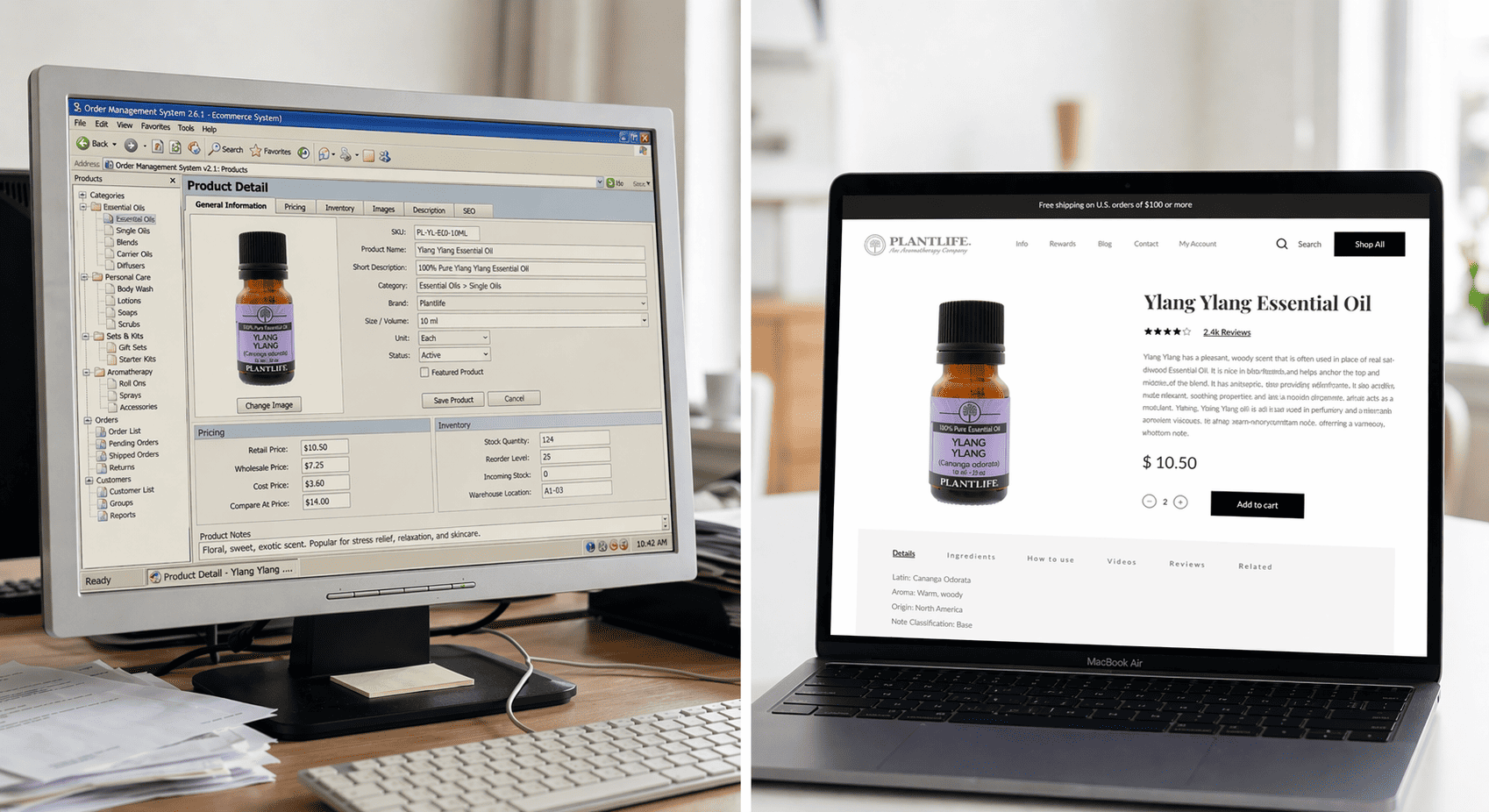


After Traffic: Why AI Shopping Channels Are the Next Growth Opportunity for CPG Brands
 Ryan Kodzik
Traffic isn’t the finish line. It’s the starting point.
For most CPG and Food & Beverage brands, the hard work begins after someone lands on your site—turning visitors into customers, customers into repeat buyers, and short-term wins into long-term revenue. Starting January 26, 2026, a major shift happened in how people discover and buy products online. Shopify rolled out agentic commerce across ChatGPT, Google AI Mode, and Microsoft Copilot, allowing shoppers to find and purchase products without ever leaving a conversation with AI.
This isn’t just another marketing channel. It’s a fundamental change in where commerce happens, and CPG brands need to understand what it means for growth.
What Actually Changed on January 26, 2026
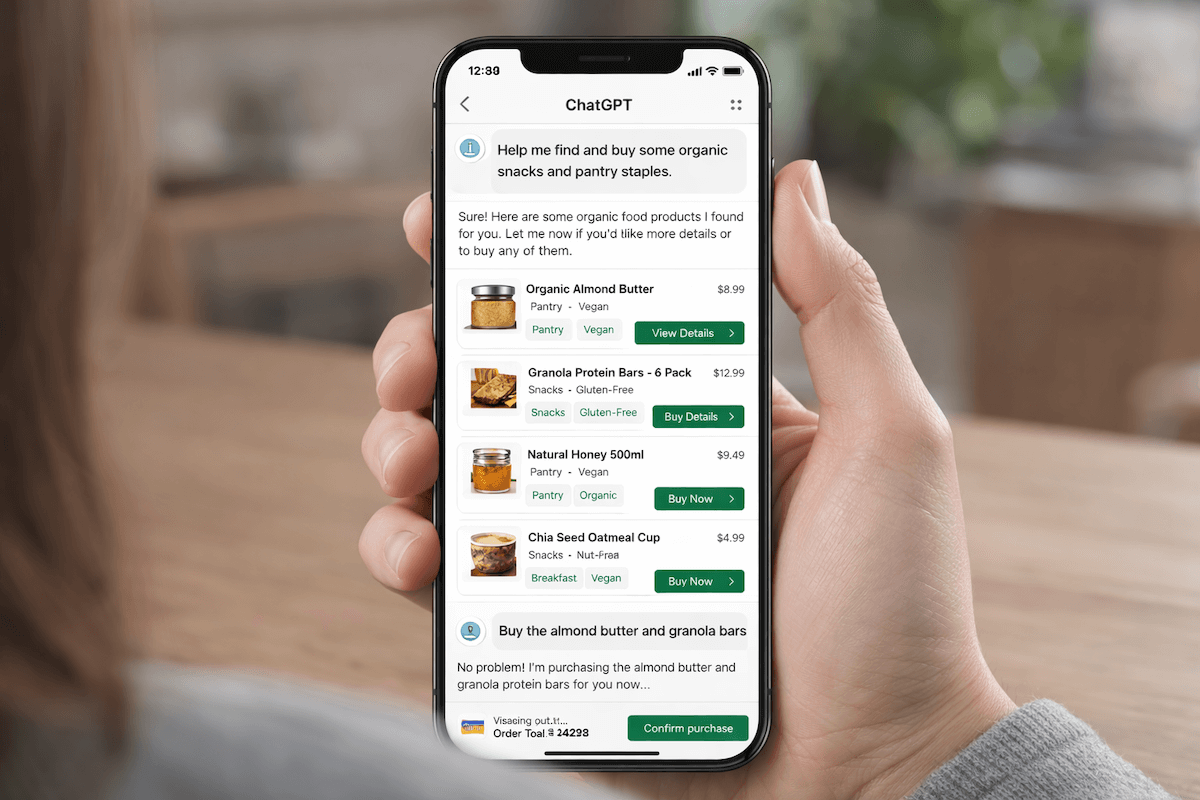
Shopify launched Agentic Storefronts as part of its Winter ’26 Edition, enabling merchants to sell directly inside AI chat platforms. Here’s what that means in practice:
Before:
A shopper asks ChatGPT “What’s a good organic hot sauce?” → ChatGPT provides recommendations → Shopper clicks a link → Lands on a website → Completes checkout
Now:
A shopper asks ChatGPT “What’s a good organic hot sauce?” → ChatGPT shows products with real-time pricing and inventory → Shopper buys directly in the chat → Order flows to your Shopify admin
The entire purchase funnel collapsed into a single conversation. Discovery, evaluation, and checkout now happen in one place—inside the AI interface.
This shift is powered by two major protocols:
- OpenAI’s Agentic Commerce Protocol (ACP), built with Stripe, enables purchases in ChatGPT
- Google’s Universal Commerce Protocol (UCP), co-developed with Shopify, enables shopping in Google AI Mode and Gemini
Both protocols were endorsed by major payment processors including Stripe, Adyen, Visa, and Mastercard, signaling this isn’t an experiment—it’s infrastructure.

Why This Matters for CPG Brands
If you’re a CPG or Food & Beverage brand, you already know DTC often takes a backseat to retail distribution. Most investment goes to shelf space, distributor relationships, and in-store visibility. But agentic commerce gives you something retail can’t: the ability to reach customers exactly when they’re asking AI for product recommendations.
Here’s why CPG brands should pay attention:
Discovery happens where intent is highest. When someone asks “best coffee beans for espresso” or “organic baby food without added sugar,” they’re not casually browsing. They’re ready to buy. AI surfaces your products at the moment intent peaks.
Repeat purchase gets easier. CPG brands live and die by repeat purchase rates. Agentic commerce makes reordering frictionless. A customer can say “reorder that hot sauce” and complete the purchase without opening a browser.
You stay the merchant of record. Unlike marketplaces that own the customer relationship, Shopify’s agentic commerce keeps you in control. Orders flow to your Shopify admin with full attribution. You handle fulfillment, customer service, and post-purchase experience just like any other order.
Margins stay intact. You pay a small transaction fee on completed purchases, similar to other sales channels, but you’re not handing over 15-30% to a marketplace. For CPG brands operating on tight margins, that matters.
How Agentic Commerce Actually Works
The technical setup is straightforward, but understanding how it works helps you optimize for it.
The Product Discovery Layer
Shopify Catalog uses signals from millions of merchants to structure product data in a way AI can understand. It infers categories, extracts attributes (organic, vegan, gluten-free), consolidates variants, and keeps pricing and inventory current across all AI platforms.
For CPG brands with high SKU counts and complex variant structures (think subscription options, bundle configurations, or size/flavor combinations), this is critical. Your catalog needs to be clean, well-organized, and properly tagged.
The Knowledge Base Layer
Shopify’s Knowledge Base App lets you upload FAQs, policies, and brand voice guidelines so AI agents have the right answers when customers ask about your brand. For example:
- “Is this USDA organic?”
- “Do you ship to Alaska?”
- “What’s your return policy?”
- “Is this safe for someone with a tree nut allergy?”
The AI pulls from your knowledge base to answer accurately in your brand voice.
The Checkout Layer
When a shopper decides to buy, the AI sends order details to your Shopify backend using either ACP (for ChatGPT) or UCP (for Google AI Mode and Gemini). You process payment through your existing payment processor, handle fulfillment exactly as you do today, and maintain the customer relationship.
The shopper sees your store name throughout the process. They know they’re buying from your brand, not from ChatGPT or Google.
What You Need to Do Right Now
Agentic commerce is live. If you’re a Shopify merchant, your products may already be discoverable in AI chats—but that doesn’t mean they’re optimized for discovery.
Here’s what to focus on:
1. Clean Up Your Product Catalog
AI agents rely on structured data to surface the right products. That means:
- Clear, descriptive product titles that include key attributes (e.g., “Organic Cold Brew Concentrate – Single-Origin Colombian Coffee, 32 oz”)
- Detailed product descriptions that answer common questions (ingredients, certifications, use cases, benefits)
- Accurate categorization so AI understands where your products fit
- Proper variant structure so customers can select size, flavor, or subscription options directly in chat
For CPG brands with dozens or hundreds of SKUs, this isn’t a small task. But it’s foundational. If your catalog is messy, AI can’t represent your products accurately.

2. Set Up Your Knowledge Base
Use Shopify’s Knowledge Base App to upload:
- FAQs (shipping, returns, ingredients, allergens, certifications)
- Brand story and positioning
- Product usage guidance
- Policy information (subscription management, auto-ship details, etc.)
This ensures AI agents answer customer questions correctly and in your voice. If you’re not providing this information, the AI will either make assumptions or skip your products entirely.
3. Optimize for AI Visibility
Think of this like SEO, but for AI recommendations. Here’s what helps:
- Structured data and schema markup
(Product schema, Review schema, FAQ schema) so AI platforms can accurately interpret your catalog - Mid-funnel content that answers real buyer questions
(“How to choose the right coffee roast,” “What makes olive oil extra virgin”)—AI agents cite content that helps shoppers make decisions - Reviews and social proof
integrated into product pages—AI considers quality signals when ranking multiple merchants selling similar products
Tools like Ahrefs, Semrush, and BrightEdge now track AI visibility, including product mentions and citations in AI responses. Start monitoring where and how often your brand appears.
4. Track Attribution and Performance
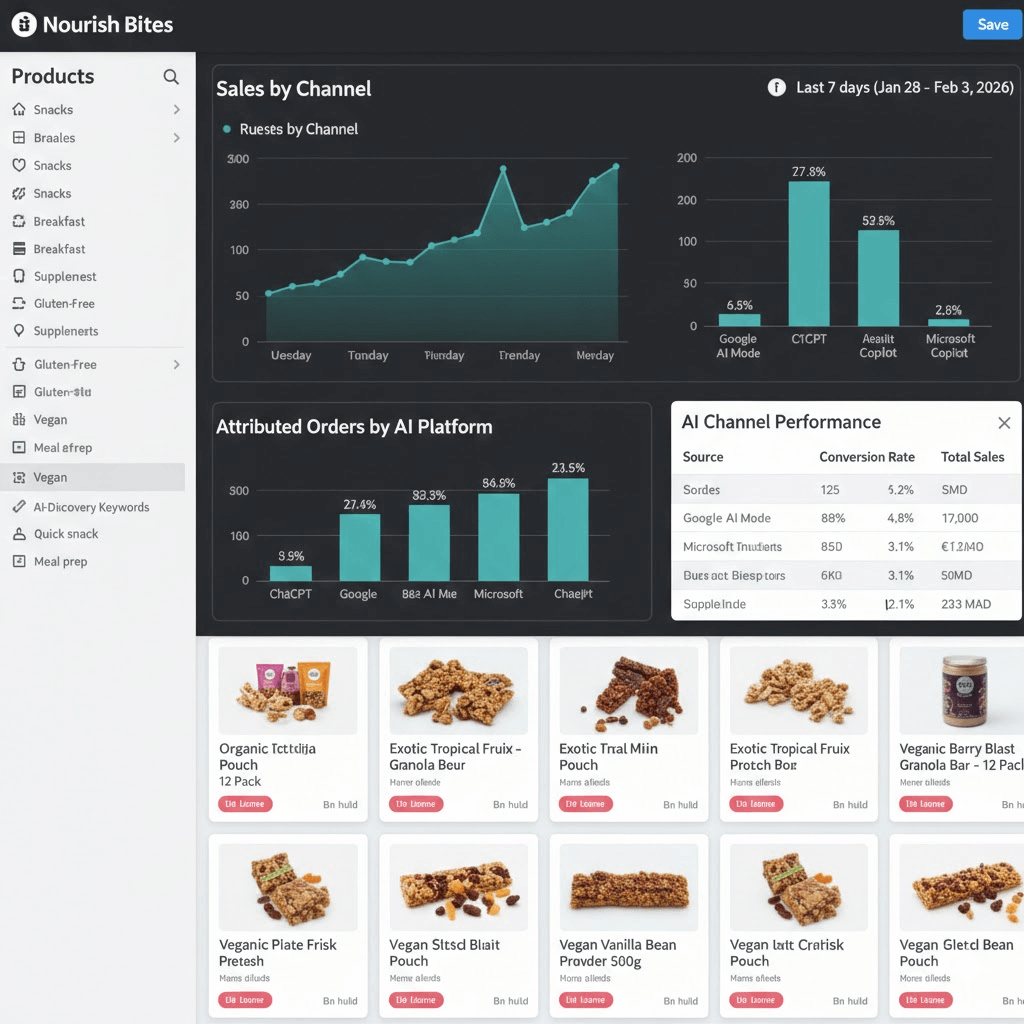
Shopify provides full attribution for agentic commerce orders. In your admin, you’ll see:
- Which AI platform drove the sale (ChatGPT, Google AI Mode, Copilot)
- Search trends and common customer questions
- How your products are being discovered
Use this data to refine your catalog, update your knowledge base, and identify which products perform best in AI-driven discovery.

What the Platforms Are Saying
The companies building agentic commerce infrastructure have been clear about what this shift means for merchants.
Shopify’s Tobi Lütke, CEO: “We’re making every Shopify store agent-ready by default.”
That’s the vision—Shopify is positioning itself as the infrastructure layer that connects any merchant to every AI conversation. For CPG brands, this means you get access to massive AI audiences without building custom integrations for each platform.
Vanessa Lee, VP of Product at Shopify: “Agentic commerce has so much potential to redefine shopping, and we want to make sure it can scale to every product a customer might want to purchase.”
The emphasis is on scalability. This isn’t a limited beta—it’s designed to work across every type of product and every type of transaction, from simple one-time purchases to complex subscription cadences and loyalty programs.
Google’s Ashish Gupta, VP/GM of Merchant Shopping: “The shift to agentic commerce will require a shared language across the ecosystem—and the Universal Commerce Protocol
provides that framework.”
Google co-developed UCP with Shopify specifically to make sure commerce works seamlessly across AI platforms. That shared language means your product catalog, checkout flows, and customer data work everywhere without rebuilding from scratch.
OpenAI (ChatGPT announcement): “This marks the next step in agentic commerce, where ChatGPT doesn’t just help you find what to buy, it also helps you buy it.”
The message: discovery and transaction are now the same moment. The traditional funnel—browse, compare, add to cart, checkout—has been compressed into a single conversation.
The takeaway from all three platforms is consistent: early movers have an advantage. Brands that optimize now will own AI-driven discovery while competitors are still figuring out what agentic commerce even means.
The Bigger Picture: Commerce Is Moving to Conversations
Agentic commerce isn’t just a new feature. It’s a shift in where commerce happens.
For the past two decades, ecommerce has lived on websites. You built a store, drove traffic to it, optimized the funnel, and measured conversions. That model isn’t going away, but it’s no longer the only model.
Commerce is now moving to wherever conversations happen—ChatGPT, Google AI Mode, Gemini, Copilot, Perplexity, and platforms that don’t exist yet. The common thread: AI agents acting on behalf of shoppers, finding products, answering questions, and completing purchases without requiring a visit to a website.
For CPG and Food & Beverage brands, this is an opportunity to meet customers in the moments that matter most—when they’re actively looking for a solution and ready to buy.
What Happens Next
Agentic commerce is in its early days. Right now, it supports single-item purchases in the U.S. for Shopify merchants and Etsy sellers. But the roadmap is clear:
- Multi-item carts are coming soon
- International expansion beyond the U.S. is planned
- More AI platforms will integrate (Perplexity already supports Shopify)
- The protocols (ACP, UCP) are open standards, inviting broader adoption
Brands that start optimizing now—cleaning up catalogs, building knowledge bases, tracking AI visibility—will be ready when agentic commerce scales.
Final Thoughts: Growth Starts After People Arrive
At Future Holidays, we focus on what happens after traffic arrives. Agentic commerce is no different. The hard part isn’t getting your products into AI chat platforms—it’s making sure they’re discoverable, accurately represented, and set up to convert.
Traffic is just the start. Growth is what comes next.
If you’re a CPG or Food & Beverage brand and want to make sure your Shopify store is ready for agentic commerce, we can help. We specialize in post-click growth—conversion, retention, and the customer experience that drives revenue. Reach out and let’s talk about what this shift means for your brand.
Ready to Optimize for Agentic Commerce?
Agentic commerce is live, and the brands that move first will own AI-driven discovery. If you’re running a CPG or Food & Beverage brand on Shopify and want to make sure you’re showing up in ChatGPT, Google AI Mode, and beyond, schedule a free strategy session with our team.
We’ll walk through your catalog, identify optimization opportunities, and build a roadmap to make sure your products are ready for the next wave of DTC growth.
Let’s build momentum.
References & Further Reading
All quotes and data in this article are sourced from official announcements by Shopify, OpenAI, and Google:
- Shopify Winter ’26 Edition – Agentic Storefronts Announcement
https://www.shopify.com/news/winter-26-edition-agentic-storefronts
- Shopify x OpenAI Partnership Announcement
https://www.shopify.com/news/shopify-open-ai-commerce
- Shopify’s Agentic Commerce Platform Overview
https://www.shopify.com/news/ai-commerce-at-scale - OpenAI: Buy It in ChatGPT (Agentic Commerce Protocol Launch)
https://openai.com/index/buy-it-in-chatgpt/ - Google: Universal Commerce Protocol & Agentic Commerce Tools
https://blog.google/products/ads-commerce/agentic-commerce-ai-tools-protocol-retailers-platforms/
Ready to put this into practice?
We build and grow Shopify stores for DTC brands, from store design and development to Klaviyo and full-scale CRO programs. If you want to talk through what this looks like for your store, book a call. No pitch, just a conversation.
Book a discovery callRelated Articles