

Why February Beat Black Friday: The StickerBros Story
 Ryan Kodzik
Most eCommerce brands build their entire revenue calendar around a single assumption: Black Friday Most eCommerce brands build their entire revenue calendar around a single assumption: Black Friday and Cyber Monday are the peak, and every other month is just maintenance. You prep the discounts, stack the inventory, and hope the holiday rush carries enough momentum to sustain the quieter stretches.
It’s a common approach. But it’s also a ceiling — and the brands that keep hitting it often don’t realize they’ve accepted it as permanent.
StickerBros didn’t accept it. And in 62 days, they had a new company record to show for it.
Why Most eCommerce Brands Are Leaving Revenue on the Table
The BFCM mindset isn’t just a calendar preference — it shapes how brands invest, plan, and prioritize their marketing channels all year long. When November becomes the north star, everything else gets treated as secondary.
The result? Email lists that go quiet from January to October. Promotional offers that never get properly activated. Audiences that are ready to buy — but never get the message.
This is more common than most brand owners want to admit. And it’s exactly the kind of problem that a focused eCommerce marketing strategy is built to solve.
For StickerBros — a brand offering vinyl stickers, decals, labels, banners, signs, promotional prints, and UV embossed stickers, a premium product that major competitors like Sticker Mule don’t even carry — the opportunity was sitting right there. It just needed someone to build the system to capture it.
The Starting Point: Six Campaigns, Two Offers, One Year
When Future Holidays began working with StickerBros in February 2025, the brand was in solid shape. Good product, real demand, and a steady stream of promotions running throughout the year. But their email marketing for eCommerce was almost nonexistent: just six campaigns sent over the previous twelve months, all promoting the same two offers.
There was no send cadence. No segmentation. No urgency structure. No variation in messaging or creative. The offers were real and compelling — they just weren’t being put in front of people in a way that drove action.
That’s the gap a strategic partner is built to close.
Building the Strategy: What Changed in February 2025
Starting in February 2025, Future Holidays built a structured email campaign strategy for StickerBros from the ground up. That meant:
- A consistent send cadence — regular touchpoints rather than sporadic blasts
- Offer variety — different angles, creative formats, and messaging frameworks beyond the same two promotions
- Urgency-driven copy — messaging designed to create genuine reasons to act now
- Strong visual design — emails that reflected the brand and made the offer impossible to miss
- Audience-first thinking — reaching new and returning customers with tailored messaging rather than a single blast to the full list
No Klaviyo flows were activated yet. Everything built in this window was campaign-based — which makes what happened next even more notable.
62 Days Later: A Record That Rewrote the Benchmark
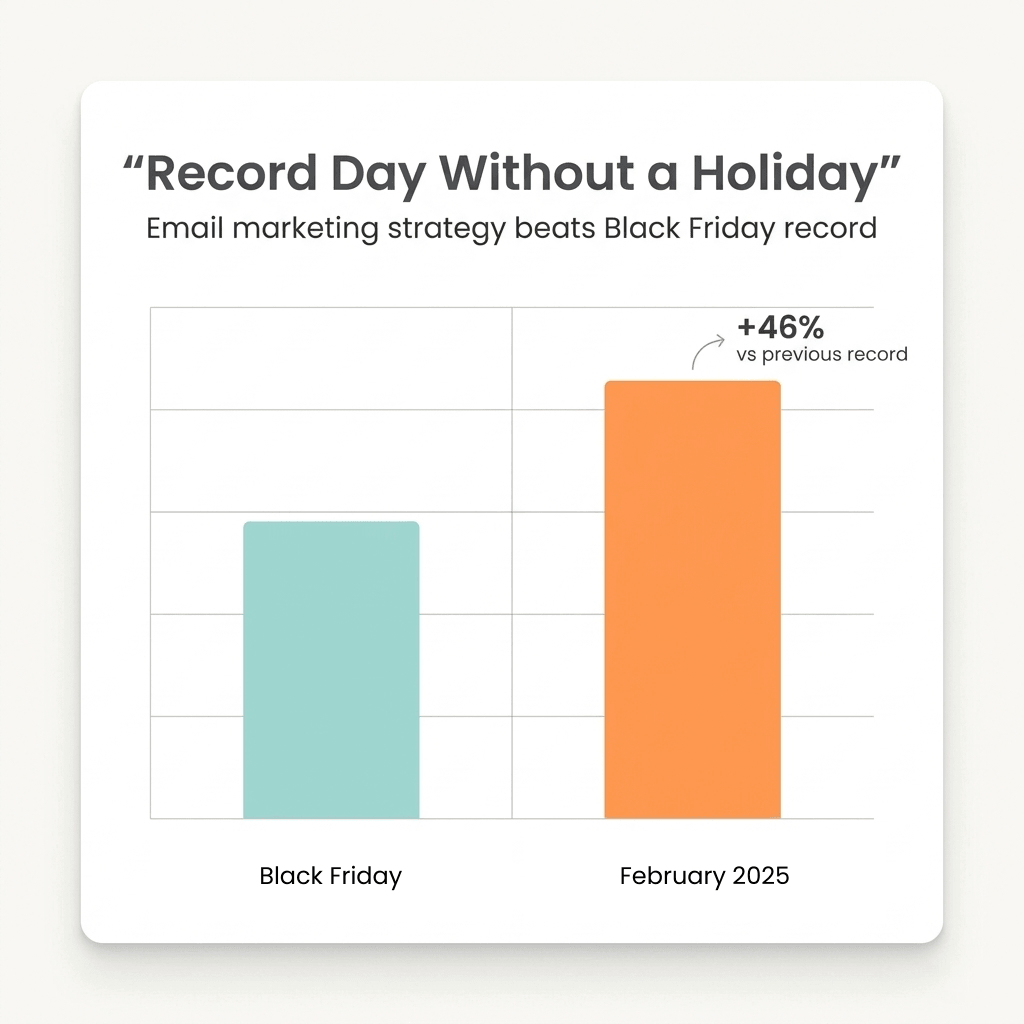
Within weeks of launching, StickerBros had their best sales day in company history —
46% more orders in a single day than their previous all-time record, which had been set on Black Friday.
Let that sit for a moment. They beat their Black Friday number by nearly half — in February. With no holiday, no seasonal consumer urgency, and no external event driving traffic. The only variable that changed was the presence of a structured eCommerce marketing strategy built to activate demand that already existed.
Sales that day split nearly evenly between new and returning customers — meaning this wasn’t just a re-engagement win. The strategy was simultaneously reactivating existing buyers and converting new ones.
Tom Christensen, owner of StickerBros, put it plainly when he shared the news with his team:
“Yesterday was a RECORD day for us. I believe the second highest day we had was last Black Friday. It was a near 50/50 split between new and existing customers. We are very excited about the new direction — between the ads and email marketing we are going to kill it this year.”
That reaction matters. It wasn’t a polished post-campaign debrief — it was a business owner messaging his team in real time because the numbers were too good not to share immediately.
The Numbers That Prove It Wasn’t a Fluke
A record-breaking day makes a great story. What makes it meaningful is that performance held through March 2025,
demonstrating that the results were systematic, not accidental.
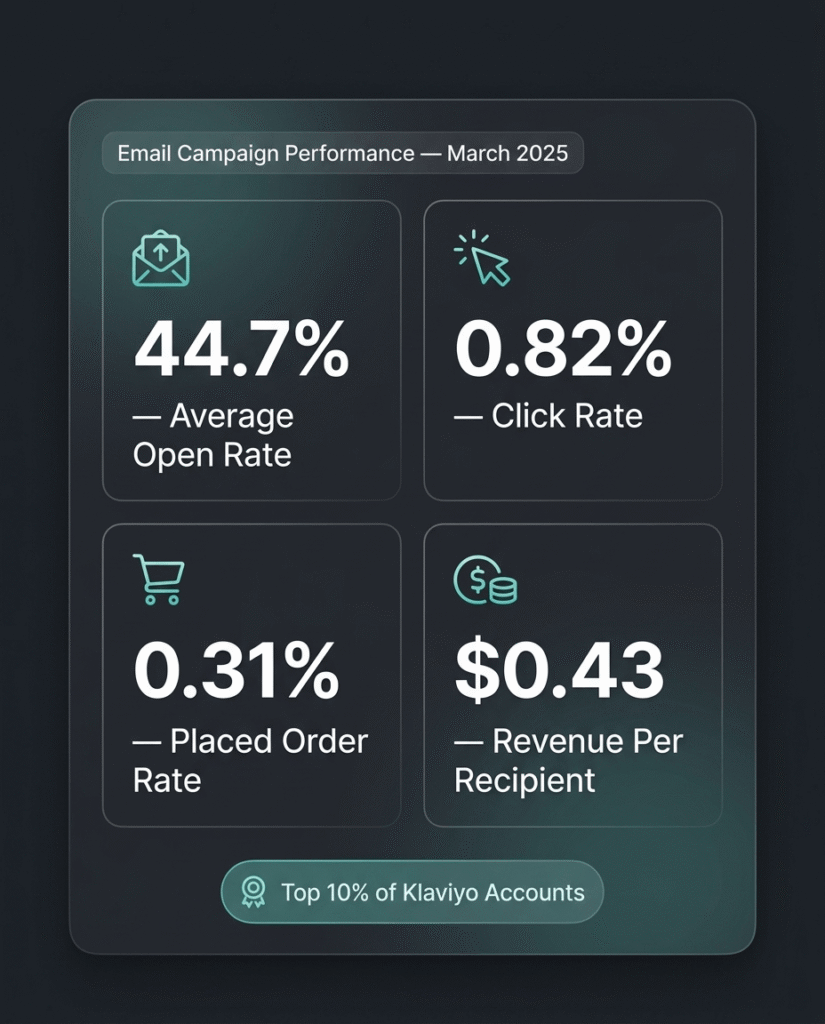
Campaign performance through March 2025:
- Average open rate: 44.7% — significantly above the eCommerce industry average of 20–25%
- Click rate: 0.82%
- Placed order rate: 0.31% — considered excellent by industry benchmarks
- Revenue per recipient: $0.43 — a strong indicator of list quality and messaging effectiveness
Deliverability metrics improved in parallel with engagement, a direct result of sending relevant content to an active audience:
- Sender score: 70 and climbing
- Bounce rate: 0.42%
- Spam complaint rate: 0.01%
These numbers reflect a healthy, well-managed Klaviyo email marketing setup — the kind that compounds over time rather than degrading with overuse.
What This Actually Means for Your Brand
StickerBros didn’t break their sales record because the product got better or the ad budget went up. The offers were already strong. The audience was already there.
What changed was the presence of a strategic partner who looked at what was sitting untouched and built a system to activate it.
That’s the real insight here: there is revenue in your business right now that has nothing to do with November. It doesn’t require a holiday to unlock it. It doesn’t require a discount deeper than the ones you’re already running. It requires consistent, well-structured email marketing for eCommerce that puts the right message in front of the right person at the right time — week after week, not six times a year.
And this is only the beginning — and that’s not a throwaway line.
Automated Klaviyo flows aren’t live yet. No welcome series. No abandoned cart. No post-purchase sequences. Every result above came from campaigns alone.
But there’s a second layer that makes this even more significant: StickerBros’ website is still mid-rebuild. Our own audit found that the Add to Cart to Checkout step is performing 25% below benchmark — meaning there is meaningful conversion friction on the site right now. That record-breaking day happened before the flows were live and before the site was finished.
Future Holidays is handling both. The full site rebuild is ours. When the new site launches alongside the automated flows, the revenue baseline doesn’t just improve — it resets entirely.
The record set in February wasn’t the ceiling. It was the starting point.
Key Takeaways
- A focused eCommerce marketing strategy can drive record results outside of peak season — no holiday required
- Sending more frequently with varied, relevant offers dramatically outperforms sporadic batch-and-blast campaigns
- New and returning customers respond differently — but both can be activated simultaneously with the right approach
- Email deliverability improves when you send content people actually want to open
- Automated flows represent significant untapped upside for brands that have only been running campaigns
Ready to Find Out What Your Off-Season Can Do?
If your best sales day is always in November, it’s worth asking what the other eleven months could look like with the right eCommerce marketing strategy behind them.
Future Holidays works with eCommerce brands to build the systems that drive revenue year-round — not just during peak season.
Let’s talk about what that looks like for your brand.
Related Articles